
Importers are rushing to hedge their dollar positions amid the sharp depreciation of the rupee against the American currency and expectations of further volatility even as exporters are holding off after suffering mark-to-market (MTM) losses on earlier hedges.

If we are able to get our act together, we may be able to see growth climb again to more than eight per cent, says Jamal Mecklai.

Most Indian companies are still quite far from having good risk management processes. The companies surveyed ranged from mid-sized (Rs 250-500 crore or Rs 2.5 to Rs 5 billion) to large (over Rs 1,000 crore or Rs 10 billion) in scale, and represented a broad spectrum of industries like IT services, textiles, engineering, auto ancillaries, conglomerates, commodity producers and consumers, agro and food, pharmaceuticals, etc.
Corporate India may be sitting on a $3 billion to $5 billion (Rs 12,000 crore - Rs 20,000 crore) notional loss on its exposure to foreign exchange derivatives. When the price of the underlying asset (derivatives in this case) depreciates, companies that have invested in these derivatives have to account for the loss in their books. This process is called marking to market.

The Indian rupee, which has depreciated 1.1 per cent so far in August, is expected to decline further on the back of a strengthening US dollar and a weakening Chinese yuan, according to a Business Standard poll of analysts. The Indian rupee hit an all-time low recently, closing at 83.15 per dollar. Five of the 10 respondents said the Indian currency might touch 83.5 per dollar in August itself, while others said the worst could be over.
The currency's relatively stable performance even as the US announced tapering showed India's better preparedness to deal with any fallout of such foreign fund outflows.

In New York market, the dollar continued to weaken against its rivals yesterday on a day devoid of major data releases out of Europe and the US.

It does feel like we are close to the end of the rupee's rally, says Jamal Mecklai.

The rupee's gains came even as most emerging Asian currencies eased as the yuan fell beyond 6.20 to the dollar for the first time since April last year amid market speculation that the central bank will keep the currency weak as economic growth slows.
Dealers attributed the fall in rupee to gains made by US dollar against the euro and other overseas currencies ahead of US jobs data and a lower opening in the domestic equity market.

Given the stability of the rupee over the last 10 months, many companies have been tempted not to hedge their foreign currency risk.
The RBI stipulated on Thursday that foreign institutional investors would require a mandate from participatory note holders to hedge on their behalf.
Forex dealers will keenly watch, instead, if the central bank indicates more measures to stabilise the currency or gives a timeframe for its current action.

The RBI governor is focused on growth, and keeping rupee slightly depreciated is part of that 'Atmanirbhar Bharat' strategy.

Since most Indian firms have kept their forex exposure unhedged, credit profile of companies in the highly sensitive sectors such as oil & gas, metal & mining, airlines could weaken substantially, says Anup Roy.

Going by the real effective exchange rate, the rupee is overvalued
To provide exporters/importers greater flexibility in risk management, RBI enhanced the limit available to exporters to 50 per cent

Analysts say the sell-off in risky assets will be temporary and could be a buying opportunity for long-term investors.
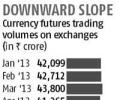
Exchange-traded currency futures volume down 80% since Jun
Banks are being squeezed every which way -- on capital, on compensation, on credibility. Jobs in financial services will become scarcer and will pay less.

RBI on Monday conducted an unprecedented level of liquidity infusion to the tune of Rs 3.3 lakh crore, in which banks bid for as much as Rs 4.5 lakh crore. The central bank said it would conduct a liquidity infusion auction of Rs 1 lakh crore on Tuesday as well, to help banks tide over the liquidity crisis.

RBI kept on adding non-SDR currencies over the next couple of years till they reached about 7.5% of reserves, which is the level they continue to hold.

The rupee appreciated by 0.27 per cent in June against the dollar.
RBI is unlikely to stem the slide against the dollar as the greenback is rising rapidly against all currencies in the world.

While the US is definitely recovering, Europe, Japan and, now, China are all going through another wave of what some fear could be a multi-year slowdown.
